Thursday, August 6, 2015

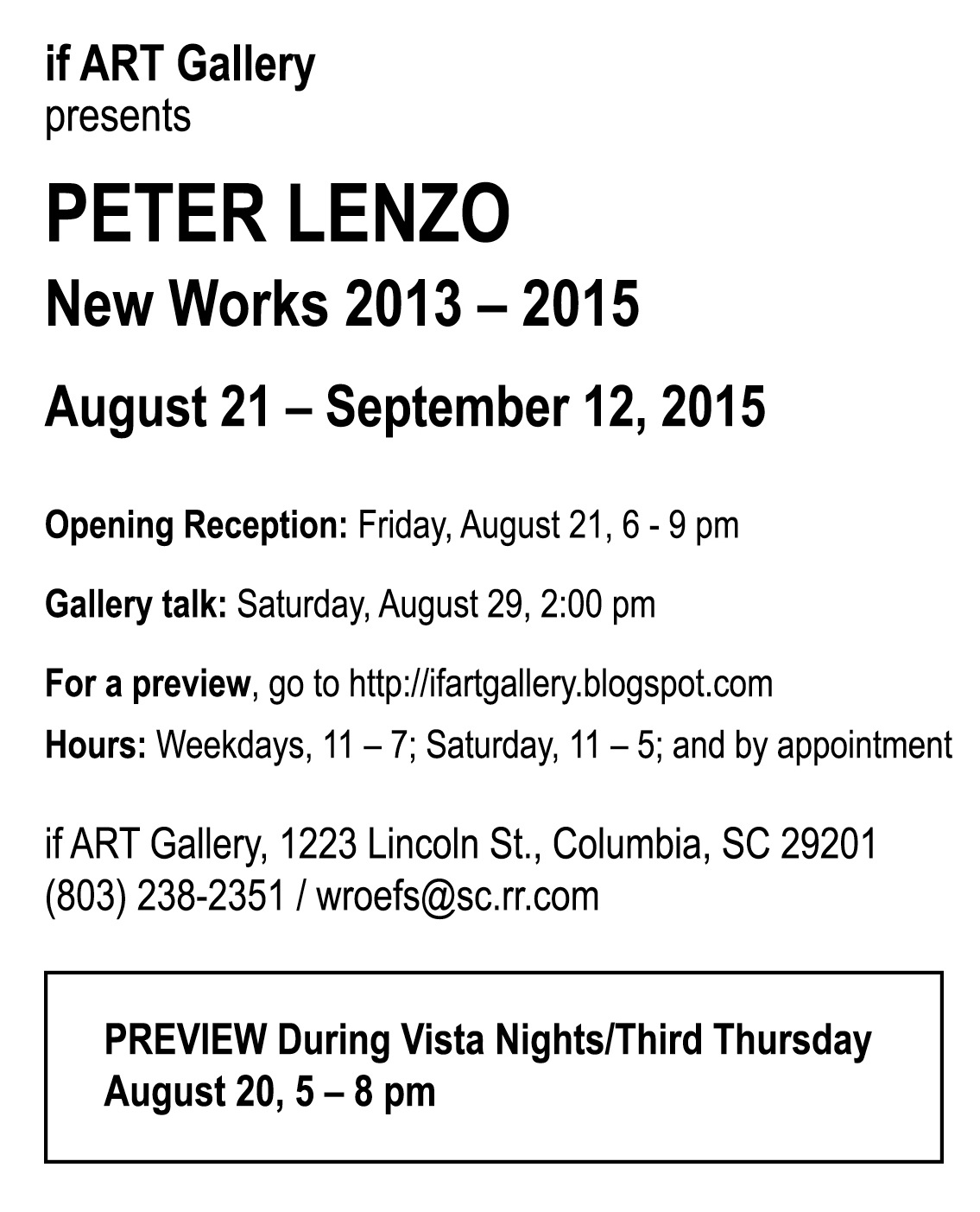
PREVIEW Peter Lenzo: New Works 2013–2015, August 21 – September 12


Red Mary, 2015, stoneware and 
porcelain clay, slips, glazes and found objects,
 
16 x 10 x 9 in., $1,200
Red Shoe, 2015, stoneware and porcelain
clay, slips, glazes, and found objects, 
18 x 11 x 8 in., $1,500/SOLD

Red Stripe, 2014, stoneware and porcelain
clay, slips, glazes, and found objects
12 1/2 x 9 x 7 in., $1,000/SOLD

Too Sad, 2013, stoneware and porcelain
clay, slips, glazes, and found objects,
  13 x 7 x 7 in., $900/SOLD


Wannabe Devil, 2015, stoneware and porcelain
clay, slips, glazes, and found objects,
11 1/2 x 8 x 6 1/2 in.,  $900/SOLD


Blue Snake, 2014, stoneware and porcelain
clay, slips, glazes, and found objects, 
 21 x 11 x 9 in.,  $1,500 / SOLD
Boom Boom Ain't It Fun To Be Crazy,
2015, 
stoneware and porcelain
clay, slips, glazes, and found objects,
 16 x 8 x 7 in., $1,100

Bronze Mary, 2015, 
stoneware and porcelain
clay, slips, glazes, and found objects,
18 x 11 x 9 in., $1,500/SOLD

Do Not Put A Stick In My Mouth Revisited, 
2013, 
stoneware and porcelain
clay, slips, glazes, and found objects, 
13 x 6 x 6 in., $1,200/ SOLD

Jim, 2015, stoneware and porcelain
clay, slips, glazes, and found objects, 
14 x 7 x x 7 in., $1,100

Left For Dead I, 2012,stoneware and porcelain
clay, slips, glazes, and found objects,
  7 x 5 x 6 in., $500
Left For Dead II, 2012,stoneware and porcelain
clay, slips, glazes, and found objects,
 7 x 5 x 6 in., $500

Maybe Two More Years, 2013, 
stoneware and porcelain
clay, slips, glazes, and found objects,
14 1/2 x 11 x 6 in., $1,300/SOLD

My Head Hurts, 2015,
stoneware and porcelain
clay, slips, glazes, and found objects,  
15 x 8 1/2 x 5 in.,
$1,300 /SOLD

Red Arm, 2015, stoneware and porcelain
clay, slips, glazes, and found objects, 
 15 x 8 x 6 in., $1,400

Red Bird, 2015, stoneware and porcelain
clay, slips, glazes, and found objects,
 20 x 11 x 7 in., $1,500


No Title, 2015, stoneware and porcelain
clay, slips, glazes, and found objects, 
16 x 11 x 7 in., $1,400

Blue Bouquet, 2015stoneware 
and porcelain
clay, slips, glazes, and found objects, 
16 1/2 x 11 x 8 1/2 in., $1,500
Canopic Jar, 2015,
stoneware and porcelain
clay, slips, glazes, and found objects,
16 x 7 x 6 in., $1,300

Nkisi, 2015, stoneware and porcelain
clay, slips, glazes, and found objects,
21 x 12 x 7 in., $1,600/SOLD

Sticks On Plate, 2015, 
stoneware and porcelain
clay, slips, glazes, and found objects,
13 x 8 x 8 in., $1,000

Almost Thanksgiving, Almost Gone, 2015, 
stoneware and porcelain
clay, slips, glazes, and found objects,
11 x 8 x 6 in., $600/SOLD

Blue Chair, 
2013, 
stoneware and porcelain
clay, slips, glazes, and found objects,
12 x 6 x 6 in., $800

Helmet Head Revisited, 2015, 
stoneware and porcelain
clay, slips, glazes, and found objects,
16 x 10 x 10 in., $1,300

Too Many Secrets/Rehab, 2015,
stoneware and porcelain
clay, slips, glazes, and found objects, 
17 x 12 x 7 in., $1,500

2 Faced With Fish, 2015, stoneware and porcelain
clay, slips, glazes, and found objects,
16 x 12 x 8 in., $1,500
Afraid To Put Into Words, 2013, stoneware
and porcelain clay, slips, glazes
and found objects, 14 1/2 x 11 x 8 in., $1,300

Wednesday, August 5, 2015

ESSAY: Peter Lenzo's Second Wind


            PETER LENZO’S SECOND WIND                                    By Wim Roefs

            “Maybe we could come up with something that conveys my newfound second wind and the fact that the work is all new,” Peter Lenzo wrote in a June text message about the title for the current exhibition. He was responding to the suggested title, “New Works 2013 – 2015.” He didn’t object strongly to the suggestion but seemed to think we could do better. “I will think on it,” he wrote.
            That didn’t happen – or, rather, if it did, the results were not revealed. “New Works” is, indeed, as over-used as it appears unimaginative. While it beats the pretentious or quasi-meaningful-but-truly-meaningless titles that burden many art exhibitions, “New Works” often communicates an absence of any attempt to capture in a short phrase the, or an, essential component of an exhibition.
            Except that for Lenzo’s current exhibition, that title does capture an essential component. That would be the very fact, no doubt surprising to many, that Peter Lenzo not only is producing new work but is doing so to the extent that a solo exhibition is in order, even required – and that there’s so much new work that bragging about it has its place.
            New Work!
            By Peter Lenzo!
            Really?
            Really!
            Not that Lenzo didn’t make any new work over past few years, but his output was modest and infrequent. A life increasingly dominated by bi-weekly seizures and the bruised and battered body parts that result from them cut into his production. So did the side effects of his medication, memory loss, headaches and the general tiresomeness of an existence heavily dependent on others and in large part spent in recovery, in bed and in a general state of inconvenience punctuated by protective head gear, a cane and leg braces.
            Lenzo himself had developed a sense of resignation and low long-term expectations, at times reflecting on whether life in his state was worth it and musing about the small number of old epileptics populating the earth. The title of a 2013 sculpture in the current show, Maybe Two More Years, captured his state of mind. Titles of not-much-older works such as Left For Dead, Suicide or Beat To Shit Then Die didn’t exactly ooze optimism, either. Nor did Near The End Dredging The Bottom Life & Death – Life & Death Daily Choice.
            At the same time, there were Old Skool Krispy Kream, ♥, Hanging With My Family or Half A Brain, Still Going Strong, titles that suggested resilience and a life not without joy. Still, “how’s Peter doing,” the question often asked in my gallery, usually comes with worried looks and body language indicating the anticipation of bad news. For the longest time, the news seldom was great. At best, it was not ungood.
            That has changed. Since April 2014, Lenzo has had six seizures rather than the 30 or more he would have had prior to that for a comparable period. He is physically much stronger. He looks great. He’s more alert than he has been in a decade. Rather than counting the low number of old epileptics, he jokes about playing basketball with his son, even though one would advise against that. There are still severe issues, such as back pain, poor sleep and milder manifestations of everything that ailed Lenzo before. But nine months in Detroit last year to help his mom regroup after his dad had died put Lenzo under new medical care. Different medication, including high CBD hemp oil, new treatments, physical therapy and a dramatic reduction of opiate painkillers has done wonders.  
            And so the vast majority of the two-dozen sculptures in Peter Lenzo: New Works 2013 – 2015 were produced in 2015. The sheer amount of post-Detroit work shows the “second wind” Lenzo was hoping to relate in the exhibition title.
Lenzo’s vastly improved health has had an impact on his work. The ability to produce more, and with more control, allows him to explore a wider range of approaches to his typical, heavily adorned ceramic heads steeped in the Southern face jug tradition. Much of his production is facilitated by Lenzo’s friend and colleague-in-clay Ed Bryan, who throws the basic, blank forms that give Lenzo the starting point for his work. “Ed has been inundating me, and that does two things. First, it makes me wonder how I am going to use the forms. Second, it has really motivated me to make more. I can still throw a little but not nearly as well as I used to. It’s something I have lost, so I have a lot of respect for it. When I used to throw them myself, and a couple of them dried out, I figured I could replace them. But now they are more precious.”
Because of better control, many of Lenzo’s recent ceramic heads look more “regular,” more precise, even though he makes sure to leave facial proportions slightly off. He’s been making more torso pieces or figures from the waist up instead of limiting himself to heads, as he had in recent years. “Ed brought a bunch of cylinder forms, so that got me to make more of the torso pieces.”
Lenzo now puts more ceramic shards and fewer whole objects in and on his sculptures, in part to be less obvious about their symbolic narratives. The origins of many shards – say, from his parents’ home – still give them the autobiographical quality typical of his work, but viewers have to dig deeper to understand and focus more on form and shape to appreciate the sculptures. And Lenzo has to make them aesthetically compelling because he can’t rely solely on objects to tell the story.
“I really like those shards,” Lenzo says. That he used them more long ago occurred to him during an exhibition earlier this year of ceramic heads he made in 2000–2002 with his then very young son Joe. “The older pieces were nothing but shards. When it’s a shard, it loses history for most people, but I think the broken pieces tell the same story. Harder to decipher, but in some ways much richer.”
In other ways, too, much of Lenzo’s current work is sparser. No longer does he have to put everything in only a few sculptures, telling the whole story at once. “When I wasn’t making that much, I was spending more time on them and put much more stuff on them. It came out of scarcity. Now I allow myself to look at a piece and decide that it really doesn’t need much more. I think of my work as autobiographical, like a journal. If you only get one page per month to write a journal, you have to put a lot of stuff on that page.”
His father’s ashes are a recurring autobiographical element in the new work. As he has done, and still does, with the ashes of his friend Jim Steven and his dog Sammie, Lenzo mixes them in slip, stains and glazes. This creates different surfaces and evocative aesthetics and, Lenzo says, takes the place of storing memories. “They replace my missing memory. I really like having those pieces around the house.  I like having my dad around. There’s my friend Jim. You can actually see them. I think it’s a much more respectful way of storing ashes than in some overpriced jar.”
“And the ashes fit the pieces. One of the pieces with dad’s ashes also has a little clay guy that my daughter Rox made when she was five. The shards come from one of the small plates that became my dad’s go-to eating plates when he didn’t have a big appetite in his last few years. My mom dropped one.”
            Because his new enthusiasm, coupled with higher energy levels, has caused him to search through vast amounts of stuff stored a long time ago and untouched since, Lenzo is using object and materials he hasn’t seen in years. Discovering dried up chunks of low-fire glazes, for instance, led him to fire pieces twice, the second time with chunks of colorful glazes running down the work as he used to do with glass. There’s more color now than in the past few years, and overall, Lenzo agrees, many of the sculptures seem less grim. “It’s a lot less grim because all the work has an autobiographical line running through it.”            
           
August 2015                                                            Wim Roefs is the owner of if ART Gallery.


Thursday, May 7, 2015

Peter Lenzo & Joe Scotchie-Lenzo: Origins 2000-2002


PETER LENZO & JOE SCOTCHIE–LENZO    
Origins 2000 – 2002

June 5 – 27, 2015

Opening Reception: Friday, June 5, 6 - 9 pm

Gallery Talk: Saturday, June 20, 2:00 pm
                                                                  
For the ESSAY Peter Lenzo And His Son's Assist, CLICK HERE.

Photography: Jim Hulin 


1-27-01, 2001, stoneware and porcelain clay, 
slips, glazes and found objects, 
11 1/2 x 8 x 6 in., $600 / SOLD
Angel Wing/Peter & Joe's Masterpiece, 2000,
stoneware and porcelain clay, slips, glazes and 
found objects, 13 x 8 x 8 in., $850.
Press Hard You're Making
7 Copies/Father & Son, 
2001,

stoneware and porcelain clay,
slips, glazes and found objects,
15 1/2 x 9 x 9 in., $900/ SOLD
            Father and Son Pierced Tongue 
            Double Snake, 2001,stoneware, porcelain 
            clay, slips, glazes and found
           objects, 13 x 7 x 7 1/2 in., $1,100


Screw Nose, 2000, stoneware and porcelain clay,
slips, glazes and found objects, 10 x 7 1/2 x 6 in.
$550
Blue Horse Nose, 2000, stoneware and porcelain 
clay, slips, glazes and found objects, 
11 x 8 x 7 1/2 in., $600.

Joe Was Here, 2000, stoneware and porcelain 
clay, slips, glazes and found objects, 
10 x 8 x 7 in., $600

Blue High Heel Kick In The Eye, 2000, stoneware
and porcelain clay, slips, glazes, 
and found objects,11 x 11 x 7 in., $700.

Barbie Snake, 2000, stoneware and porcelain
clay, slips, glazes and found objects, 
10 1/4 x 5 x 4 1/2 in., $800/SOLD

Happy New Year/Turtle, 2000, stoneware and porcelain
clay, slips, glazes and found objects, 8 x 6 x 7 in.
$ 550.

Barbie Doll Leg Nose, 2000, stoneware and 
porcelain clay, slips, glazes and found objects,
12 x 7 x 7 in., $750

Pink Kick In The Eye, 2000, stoneware and 
porcelain clay, slips, glazes and found objects,
9 x 6 1/2 x 5 1/2 in., $550.

Peter & Son/2 Blue Horse Devil, 2000, 
stoneware and porcelain clay, slips, 
glazes and found objects, 
12 1/2 x 8 x 7 in., $750

Snake Eye Leaf Eye/Wild One, 2000, stoneware
and porcelain clay, slips, glazes and found 
objects, 12 x 8 x 7 in., $700.

Leaves and Sticks, 2000, stoneware and porcelain 
clay, slips, glazes and found objects, 
13 x 7 x 6 in., $700.

Triple Arm Kiss, 2001, stoneware and porcelain 
clay, slips, glazes and found objects, 
13 x 9 1/2 x 7 in., $850.


Where It All Began -Joe For Daddy, 2000,
stoneware and porcelain clay, slips, glazes
and found objects, 7 x 7 x 6 in., $800
SOLD
12-30-2000, 2000, porcelain and stoneware
clay, slips, glazes and found objects,
9 1/2 x 7 x 7 in., $600

09-29-2000 Shards, 2000, porcelain and
stoneware clay, slips, glazes and found objects,
10 x 7 x 7 in., $600

Pokemon, 2000, stoneware and porcelain
clay, slips, glazes and found objects,
12 x 8 x 6 1/2 in., $700

Triple Snake Kick In The Eye, 2000,
stoneware and porcelain clay, slips,
glazes and found objects,
10 1/2 x 8 x 6 in., $650

Virgin Mary Snake, 2001,
stoneware and porcelain
clay, slips, glazes and found objects,
14 x 8 x 7 in., $800

Tuesday, May 5, 2015

ESSAY Peter Lenzo & Joe Scotchie-Lenzo: Origins 2000–2002


PETER LENZO AND HIS SON’S ASSIST                                    By Wim Roefs

            “I made my dad famous,” Joe Scotchie-Lenzo used to say about the ceramic artist Peter Lenzo.
            “He started saying that right away,” says his dad.
            He still does. “I like to take credit for it,” Scotchie-Lenzo says, grinning.
            Of course, Lenzo already had a considerable reputation, mostly with his cabinet-like altarpieces filled with found objects and personal mementos and slowly, also, for more traditional-looking face jugs steeped in Southern tradition. But Lenzo’s son did steer his dad in the direction he now is known for nationally – highly embellished, at times frightening ceramic figures and faces adorned with found and created objects sticking in and out of bodies and faces that are at times unrecognizable as the face jugs from which they originate. The adornments range from ceramic shards to found or purchased porcelains dolls, animals, pipe heads, trains, shoes, roosters or Virgin Mary statues and snakes, leaves, sticks and other things that Lenzo makes himself.
            The son created the dad’s breakthrough in 2000 at age four, the year after Lenzo had begun to make face jugs. At his father’s side, little Joe had already created face jugs, which Lenzo still likes to hold up, marveling at the untrained skill, looseness and good but asymmetrical features. Then the son started to stick stuff into Lenzo’s jugs.
            “One day, I had a finished face jug on the table in my studio,” Lenzo says. “I had a bowl of teeth, and Joe asked ‘can I put some teeth in the head?’ I said ‘okay’. And off he goes.
            ‘Can I stick one in the eye?’
            ‘In the nose?’
            That piece I kind of looked at as Joe having fun. I put it on the shelf, and it gathered dust for several months. Then I looked at it again and liked it. I put it in the kiln, and it came out so fantastic. So I wanted Joe to do some more, and he was so thrilled.”
            The son went to work, also with brushes and different colored slip that he would mix. “It turned all black,” Lenzo says. “That was one of his specialties, turning them black.” The son wanted to put a snake on the jug but didn’t like the one he had made, so Lenzo made him some snakes. “He wanted leaves and sticks, but real ones can’t work,” Lenzo says, “so I made him some of porcelain and pre-fired them so that they wouldn’t break.”
            The next request was shoes. “I saw some in an antique store,” Lenzo says. “That started me buying stuff from thrift stores and such.” His son’s invention of putting a doll head in the eye especially excited Lenzo, and he would do so many times himself. “Then he wanted to put Pokémon on it, so he just stuck some shards in it and said it was Pokémon. And we named one Pokémon.”
            Lenzo would keep finished clay heads under plastic for when his son was ready to go. Sometimes Joe would do one, other times three or so in a single sitting. He would work with both hands at times. “There was never any hesitation,” Lenzo says. “He just attacked it. He was so focused. Then one day he said he was done. He didn’t want to do it anymore. And he didn’t.”
            The son would continue to tag along with his dad in the studio, the middle school classroom where Lenzo taught or later after school at Southern Pottery, the ceramics gallery and studio that Lenzo owned at the time. Like his sister, Roxanne, he would create his own face jugs at times. Some sold alongside his dad’s for hundreds of dollars to serious collectors.
            “I thought it was crazy when one of my pieces sold for more than $100,” says Scotchie-Lenzo, now 19. Some went for $300 or $400. One ended up in the South Carolina State Museum; a father-and-son co-production is in the Smithsonian. But three years ago, the son stopped altogether.
            “I don’t know why,” Scotchie-Lenzo says. “It wasn’t as much fun as it used to be. I had fun as a kid sticking stuff in faces, but later it became more like work. Doing the whole thing – it took a lot of time.” Increased skill levels also increased expectations, making the process harder. He has less time now, he says, and isn’t around his dad and the studio as much.
            “I never really wanted to become an artist. Both my parents were. My whole youth was spent around artwork, and I’ve seen so much. I love it, but I’ve been around it all my life. I am not put off, but it was hard to see myself do that also. I can do something else that I am not familiar with.”
            “But I like the idea of this exhibition. Seeing these pieces again brings back memories of working in the studio. I like these pieces because they are so random. It makes me want to go back and see what I can do now.”
            “The technique,” as Lenzo calls it, that Scotchie-Lenzo had invented out of the blue as a four year old changed his father’s perspective. “Sticking fired clay into wet clay was not done and is still not done,” Lenzo says. “When it didn’t crack during firing, I was really surprised.”
            The ruthlessness with which Scotchie-Lenzo attacked nice faces that Lenzo had labored over showed an attitude the latter didn’t have then. “I was never able to do that. Those faces were precious. Sometimes I would distort a face or only work around it but not destroy it. What Joe did almost seemed a sign of disrespect for what I had done. It didn’t bother me, but it shocked me at first. A couple of them, you didn’t even know they were a face. But I really like the idea of sticking these things in the heads and became more deliberate about what I would stick in there.”
            Attaching objects to clay faces and figures gave Lenzo a new vehicle for telling stories when he could no longer do so by putting objects in finely crafted wooden alter pieces. In the 1990s, brain damage from a bicycle accident in his youth had caught up with him, and he increasingly suffered from seizures. Working with a table saw and other power tools to create the altars was an accident waiting to happen. As a result, Lenzo had switched to clay exclusively, making Southern-style face jugs.
            “To me it was like telling stories,” Lenzo says about his new direction. “Stories on the outside while the head was empty, which was a good metaphor for what I was going through. All these drugs, the bad reactions to them, my memory getting worse – having those heads empty seemed apt.”
            “It was a transitional time for me,” Lenzo says. “My seizures went from once every six months to every week or ten days. Everything stopped: Teaching, working with power tools, walking by myself. Life got squished. I wasn’t able to achieve much. When I started working with Joe on the face jugs, I started working more in clay.”
            Both father-and-son co-productions and Lenzo’s solo work in the new vein got noted, earning Lenzo representation at SOFA New York and Chicago, solo exhibitions in prominent galleries in Atlanta and Massachusetts and a growing reputation. Lenzo loved making traditional face jugs but worried about abandoning the fine art world from which he came. The new work bridged the gap. “Working with Joe gave me a direction to go in when I didn’t know where to go. I wouldn’t say Joe made me famous, but he made me sane.”

                                                                           Wim Roefs is the owner of if ART Gallery

                                                                                                                            May 2015


       Peter Lenzo & Joe Scotchie-Lenzo        

            Columbia, S.C., resident Peter Lenzo (b. 1955) is a widely recognized ceramic sculptor with a national profile. The New York City native, who grew up in Detroit, was selected for the 1995 and 1998 South Carolina Triennial exhibitions at the South Carolina State Museum in Columbia; the 2011 exhibition Triennial Revisited and the 701 CCA South Carolina Biennial 2011 and 2013, all at 701 Center for Contemporary Art in Columbia; and Thresholds, a 2003 exhibition of Southeastern art dealing with religion and spirituality that traveled extensively throughout the Southeast.  
            Lenzo’s work is in several museum collections, including at the South Carolina State Museum, the Mint Museum in Charlotte, N.C., and the Renwick Gallery at the Smithsonian Museum in Washington, D.C. His solo exhibitions include those at the Spartanburg (S.C.) Museum of Art, the European Ceramic Work Center in Den Bosch, The Netherlands, Great American Gallery in Atlanta and Ferrin Contemporary gallery in Massachusetts.
            Lenzo and his work have been featured in numerous books, exhibition catalogues and articles about ceramic sculpture and Southern art. They include the Threshold catalogue, 500 Figures In Clay (2005), Robert Hunter’s Ceramics in America (2006) and Poetic Expressions of Mortality: Figurative Ceramics From the Porter–Price Collection (2006). He holds an MFA from Wayne State University in Detroit and used to teach at the University of South Carolina, Columbia.
            Joe Scotchie-Lenzo (b. 1996) is Peter Lenzo’s son. He has been making and selling ceramic sculptures off and on since he was four years old, although he hasn’t produced any in three years. One co-production with his dad is in the collection of the Smithsonian’s Renwick Gallery. One of his individual works is in the South Carolina State Museum collection. Scotchie-Lenzo is a native and resident of Columbia, where he is a business major with an interest in retail and clothing at the University of South Carolina.
Friday, March 1, 2013

ZOOLOGICAL SOCIETY, March 22 - April 2, 2013


To see work from artists in Zoological Society click on their names: 
Roland AlbertCarl BlairSteven ChappPhil GarrettTonya GreggDiane Kilgore Condon,Peter LenzoPhilip MorsbergerMarcelo Novo,Anna RedwineKees SalentijnLeo Twiggs andDavid Yaghjian. 

For a PREVIEW of the exhibition  CLICK HERE


To see installation shots of the exhibition CLICK HERE

Monday, October 22, 2012

18/100 Southern Artists The if ART Contingency, October 28- November 17, 2012

18/100 Southern Artists
The if ART Contingency

October 28 - November 17, 2012

@ if ART Gallery
1223 Lincoln St. 
Columbia, SC

1 new book about Southern artists
100 artists in the book
18 of 100 artists from if ART Gallery

ARTISTS' RECEPTION & BOOK SIGNING
Sunday, October 28, 2 - 4 pm

To view works of art available at if ART Gallery featured in 100 Southern Artists CLICK HERE

For more information, contact Wim Roefs at if ART Gallery
(803) 238-2351/ wroefs@sc.rr.